Thursday, 1 October 2009

Poemenius


I recently came across this coin that was languishing in a junk box of sorts. I realised straight away that it was a coin of the “rebel” Poemenius, struck in the name of Constantius II. Poemenius, you ask, who’s that?

References are scant and the only extant literary reference for Poemenius is Ammianus 15.6.4: “...Poemenius was condemned as a malefactor, hailed to execution and perished; he was the man (as we have told above) who was chosen to protect his fellow-citizens when Trier closed its gates against Decentius Caesar”. Sadly the writings of Ammianus prior to 353 are lost and we can only wonder what else could be learned if that part of the text remained.

At the time of the civil war between Constantius II and the western usurper Magnentius, the imperial administration was based at Trier. However, the real centre of military power was on the frontier at Cologne and Mainz, leaving the former relatively undefended in the case of attack. By spring, 352 the Trier region was suffering attacks from Germans who had been prompted by Constantius to attack his rival’s centre of power. Poemenius, for whatever reason the most important man left inside the walls of the city, during the resistance to the barbarians had seemingly declared for Constantius – prompting Magnentius’ brother, Decentius, to besiege the town. The rare series of hybrid coins honouring Constantius on the obverse and using the chi-rho type of Magnentius on the reverse were all struck in Trier and are therefore presumed to be a product of Poemenius’ counter-rebellion. The fate of Poemenius is known and Ammianus notes that he was executed after his stand against Magnentius. The period of the revolt was brief, probably lasting a little over one month in the middle of 353.

My example of this scarce issue has been cut down, removing most of the obverse and reverse legends. It has been done in such a way as to preserve the religious symbol, the chi-rho, on the reverse and may have been to mount the coin as a religious pendant.

Although the legends have been largely removed it is possible to identify the portrait as being that of Constantius, rather than Magnentius or Decentius as there is a diadem, only present on the coins of Constantius.

Monday, 17 August 2009

My sad world.........


Welcome to my sad world!!!!!!

Whilst I was in Filey I happened to notice my first 2009 coin in circulation on Saturday 15th August; a penny.

Bronze age archaeology in action

Ferriby boat replica puts to sea with Filey Brigg in the background where a late Roman signal station was located


I was at Filey this weekend on the east coast of Yorkshire. There were a series of events to raise money for the RNLI and Filey lifeboat and one of these events included putting to sea a half size replica of one of the Bronze Age "Ferriby Boats".


The Ferriby boat replica, cutting edge Bronze Age technology, with the Filey lifeboat behind, cutting edge modern technology

The Ferriby Boats are three sewn plank-built boats, parts of which were discovered at in the East Riding of the county of Yorkshire. Only a small number of boats of a similar period have been found in Britain and the Ferriby examples are the earliest known boats to be found in Europe. The crew said she was good in the water but a little heavy to manoeuvre.

For more information on the Bronze Age boats go to http://www.ferribyboats.co.uk/

Friday, 3 July 2009

Edward Jekyll - a bookplate traced


I bought the two volumes of the "Coin Collectors Manual", 1853, by Humphreys years ago when I was just beginning to develop an interest in numismatic literature. Looking at the price paid, £20 in 1990, it was probably too much.


Inside each one there is a name inscribed in black ink plus a bookplate with the name Edward Jekyll. Curiously this is the name of the doctor in Robert Louis Stevenson's 1886 book "The Strange Case of Doctor Jekyll and Mr Hyde" - but more of that later.


I searched Edward Jekyll on the internet and came up with such a name related to Gertrude Jekyll (1843-1932). She an influential British garden designer, writer, and artist who created over 400 in the UK, Europe and the USA.


Then I came upon a link to an excellent family history website about the Archers, the Goodmans and Associated Families who included the Jekylls. On the page of Jekylls, including Gertrude Jekyll, is reproduced the crest from the bookplate - I had been fortunate enough to track down the right family.

So which Edward Jekyll is it? I'm not sure. It must be either Captain Edward Joseph Hill Jekyll (6 Feb 1804 - 26 Mar 1876) of the Grenadier Guards, father of Gertrude, or his son Captain Edward Joseph Jekyll (18 Aug 1839 - 3 Mar 1921) of the 64th foot, and therefore Getrude's brother. Looking at the membership of the Royal Numismatic Society does not help narrow this search down as the name does not appear to be present on any of the membership lists sadly.

So where is the connection to the horror story? Well Edward jr. and Gertrude had a younger brother, Rev Walter Jekyll, who was a friend of Stevenson and who borrowed the family name for the main character in the book.

Wednesday, 17 June 2009

What's so bad about firemen?

In book 10 of Pliny's letters, that is the volume that charts the correspondence between him (as a special imperial delegate in Bithynia) and the emperor Trajan, there is a rather intriguing exchange.

In letter 33 Pliny informs the emperor of a serious fire that broke out in Nicomedia that detroyed many houses plus two public buildings, the Elder Citizens Club and the Temple of Isis. He suggests that he might form a company of firement, numbering about 150 or so also noting that any privileges granted would be monitored and not abused.

Trajan's reply is very suspicious, saying that although is it a reasonable idea it is groups or societies like those that have been responsible for political unrest within the province. "If people assemble for a common purpose, whatever name we give them and for whatever reason, they soon turn into a political club. It is a better policy then to provide the equipment necessary for dealing with fires, and to instruct property owners to make use of it, calling on the help of the crowds which collect if they find it necessary."

Saturday, 13 June 2009

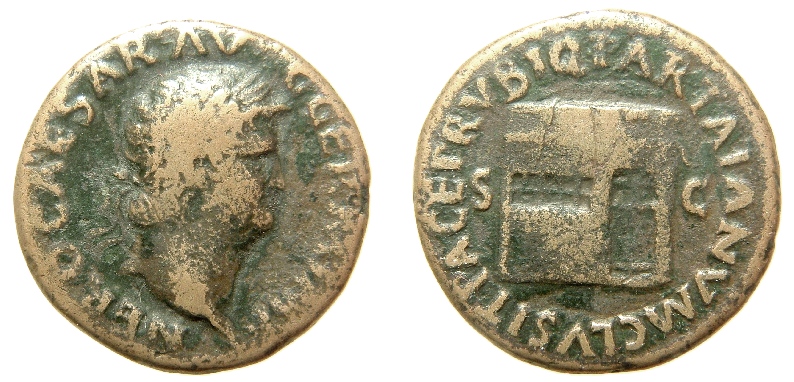
The Doors of the Temple of Janus are shut.

Nero 54-68 AD
AE as
Obv "NERO CAESAR AVG GERM IMP"
Bare bust right
Rev "PACE P R VBIQ PARTA IANVM CLVSIT SC"
Temple of Janus with doors closed
Rome mint
RIC 306
There is a series of well known sestertii, dopondii and asses issued by Nero that show the Temple of Janus with closed doors. It is also widely known that the closing of the door was symbolic of peace throughout the Roman Empire. But, what is not widely known is why the doors being shut came to represent peace........


Hill's Monuments of Rome as Coin Types (1989) offers some suggestions as to where the temple was located but does not provide an answer to our question. Similarly Stevenson's Dictionary of Roman Coins (1889) can offer us that Livy tells us that the doors were mostly open, in fact were shut only once, from the foundation of Rome to the battle of Actium, but again not why they should be shut. Suetonius reckons that Nero's closing was the third occasion on which the doors were shut.


The answer, however, does appear in Donaldson's Architectura Numismatica (1859). In it he tells us that, according to legend, the original Temple of Janus was built by either Quirinus or Romulus. He notes that, according to the ancient writer Macrobius, during the Sabine wars the enemy were rushing into Rome through the Porta Janualis when they were overwhelmed by a vast torrent of boiling water which impetuously flowed from the Temple of Janus. From then it was decreed that as Janus had come to their help during a time of war the doors should remain open.

Saturday, 6 June 2009

A handful of spits


Ionia - Klazomenai
AR obol
c.520-480 BC
Forepart of a winged boar right
Quadripartite incuse square

When I first read that in Seaford's "Money and the Early Greek Mind" I have to admit I had the wrong end of the stick! I now know the "spits" referred to were made of iron and were of the type used for roasting meat.

You see a "spit", or "obelos", gave its name to the small Greek silver coin we know as the obol. Given that small change could be carried in the mouth then my misunderstanding was, I think, excusable.

The term "drachma" means handful, particularly six (as noted by Aristotle, for example), and so we get "obeliskon drachmai" - a handful of spits - being used in temple inventories and inscriptions. These must be referring to bundles of iron rods, not the grudging payment in the hand of small silver coins. It was only later that these two terms began to have a specific reference to money.