Monday, 21 March 2016

Bainbridge Roman fort


I found myself in the Yorkshire Dales on Sunday and decided to head on up to Bainbridge to see the Roman fort.

The very well-defined almost square-shaped earthworks of Bainbridge Roman fort, lie just a little to the east of the village on the opposite side of the river Bain (England’s shortest river) at a place called Brough. The Romans called this fort Virosidvm – ‘the settlement of true men’. Thought to have been built in the Late Flavian period and abandoned by the late 4th century, it has a single ditch surrounding the north, east and south sides.

Three Latin inscribed building and military-type stones found here record that rebuilding took place after it was burnt to the ground in the early 3rd century AD – the rebuilding being carried out by the VI cohort of Nervi or Cohors Sextae Nerviorum. An earlier 2nd century timber fort was replaced by one made of stone, something that happened at many Roman forts in Brittannia. As well as the three stones with Latin inscriptions a further stone bearing a crudely carved mermaid was discovered and also substantial amounts of metalworking material and ingot moulds. It is believed there are Roman stones built into a number of cottages and farm buildings in and around Bainbridge.

The photograph of the fort was taken from the road leading up to Semerwater. Semerwater is the largest of only three natural water bodies in Yorkshire. It is a glacial lake which was formed at the end of the last Ice Age when huge amounts of glacial till blocked the outflow from Raydale.

Tuesday, 15 March 2016

A medallion of Marcus Aurelius

I have just acquired an extremely rare medallion of Marcus Aurelius.


Marcus Aurelius
AE medallion
Rome mint
Obv: M AVREL ANTONINVS AVG GERM SARM TRP XXXII
Laureate, draped bust right
Rev: IMP VIIII COS III PP
Emperor standing right, turning left and crowning a trophy of arm with two captives below
Gnecchi II, pl 59, 6 (obv), Gnecchi II, pl 60, 9 (rev)

Medallions were produced during the Roman empire predominantly as new year gifts. The dating on this medallion, using the TRP, IMP and COS titles, show this medallion was struck for the year December 177 to December 178 AD for the 1st of January 178 AD.

Gnecchi II, pl 60, 9


The dating of the medallion, with the reverse type that clearly shows a scene of victory with the trophy of arms with the captives seated below, must be a celebration of the outcome of the first Marcomannic war (162 through to 176). On December 23rd Marcus Aurelius, together with his son Commodus, celebrated a joint triumph for his German victories ("de Germanis" and "de Sarmatis" that appear in the obverse titles of this medallion). I suspect the victory celebration occurred too late for the medallions for January 1st 177, given the iconography of the reverses of the other medallions dated to TRP XXXII (December 177-178).


Gnecchi II, pl 59

In commemoration of this victory the Aurelian Column was erected, in imitation of Trajan's Column.

The Aurelian column

Sunday, 7 February 2016

Burgh Castle and Caistor, Norfolk


In 2015 I had a summer break in Norfolk. It is such a historic county and I had the opportunity to visit a few Roman site whilst there. Included in that is what must be my second favourite Roman site of Burgh Castle.

Burgh Castle

Gariannonum, or Gariannum, was a Saxon Shore fort in Norfolk, England. The Notitia Dignitatum, a Roman Army “order of battle” from about AD 400, lists nine forts of the Saxon Shore in south and east England, among which one was called Gariannonor. It has been much discussed over the years in terms of spelling (Gariannonum, Garianonum, Gariannum), purpose (whether it really was intended for defence against Saxon raids), and location (whether Burgh Castle or the Caister-on-Sea site).

 Caistor Roman fort

Gariannonum has usually been identified with Burgh Castle. However, modern reassessment of the Roman settlement 9 kilometres (5.6 mi) away at Caister-on-Sea has shown that it too had a military function. In Roman times, both sites lay on opposite sides of a large estuary (the remnant of which is Breydon Water). The identification of Burgh Castle as Gariannonum is uncertain, and the name could apply to Caister-on-Sea.

Burgh Castle

The name Gariannonum has been thought to derive from a Celtic root meaning "babbling river," which may refer to the River Yare at Burgh Castle, although the derivation is uncertain. The military function of Caister-on-Sea is also open to doubt. Both sites probably operated together and one, or possibly even both, were known by the Romans as Gariannonum.

The fort is roughly rectangular measuring (internally) approximately 205 m (673 ft) by 100 m (330 ft). The walls on the north, east, and much of the south side are largely intact, standing at a height of approximately 4.6 m (15 ft) and measuring up to 3 m (9.8 ft) thick at the base. They have a core of mortared flint rubble and an external and internal facing of prepared flint and red tile or brick in alternating bands. Against the outer face of the walls there are six solid bastions of pear-shaped plan spaced symmetrically, two on the south wall, one each at the north east and south east angles, one slipped from position on the north wall, and one below the south wall where it has fallen. The west wall has at some time in the distant past collapsed down the underlying hillside and into what was once an estuary but is now a marsh, and nothing of it is now visible. Breydon Water is all that is left of the estuary this fort once overlooked.

Burgh Castle

Coin and pottery evidence on the site indicates that the occupation of the fort dates from the mid-3rd century AD, with Roman occupation continuing up to the early 5th century AD when the integration of Roman and Saxon traditions appear.

Saturday, 23 January 2016

The Mithreum at Carrawburgh


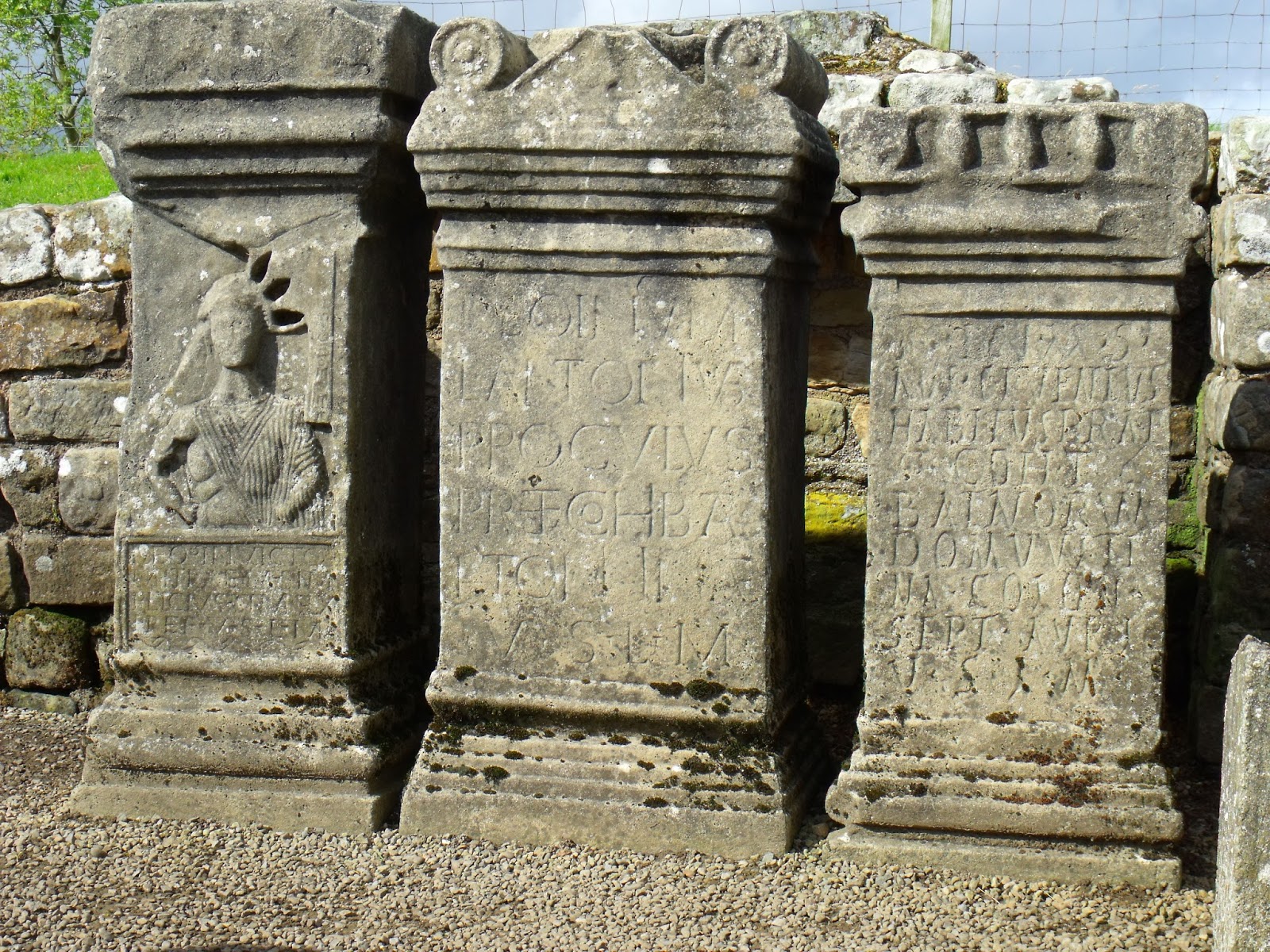
I had the opportunity this weekend to visit the temple dedicated to Mithras on Hadrian’s Wall behind the auxiliary fort of Brocolita at Carrawburgh, Northumberland.

The remains of an early 3rd century mithraeum was discovered in 1949 and excavated by Ian Richmond and J.P. Gillam in 1950, and is the second-most northernly mithraeum discovered so far. The Brocolitia mithraeum is also the only sanctuary outside the Rhine provinces from which a monument of the goddess Vagdavercustis has been recovered. Like most other mithraea, the Brocolitia temple was built to resemble a cave, and also had the usual anteroom, and a nave with raised benches (podia) along the sides. At Brocolitia, the anteroom and nave were separated by a wattle-work screen, the base of which was found exceptionally well preserved.


The three altars found there were all dedicated by commanding officers of the unit stationed here, the First Cohort of Batavians, a Germanic people from the Rhineland. From left to right in the picture the named commanders are Marcus Simplicius Simplex (RIB 1546), Lucius Antonius Proculus (RIB 1544) and Aulus Cluentius Habitius (RIB 1545).

Mithraism is a Persian religion, with many aspects similar to another minor eastern Roman religion, Christianity, where the proponents are given the hope of a better afterlife rather than improving the current life and through this became a favourite of the Roman army.

Monday, 18 January 2016

The Roman mosaic from Well


On my recent visit to Masham I had the opportunity to photograph a Roman mosaic that I had wanted to see for a long time, but for one reason or another never had. The pavement fragment from a villa and bath house complex is located in the church in the nearby village of Well.
 
The corner fragment of mosaic that is preserved features various classic designs of both guilloche and latchkey for the border and a central geometric design that imitates cubes in 3d. It dates presumably from the third or perhaps fourth century AD.

Sunday, 10 January 2016

The Temple of Aphrodite, Paphos, Cyprus


AE19mm, Augustus, Paphos, RPC I 3906
It’s been a long time since I visited the temple of Aphrodite at Palaeo Paphos, also known as Kouklia, on the island Cyprus, so much so that I can’t find the photographs that I took (back in October 2000). However a recent coin acquisition has taken me back there.


The coin, of the emperor Augustus from the island of Cyprus, features the temple as its reverse design with, at its centre, the conical meteoric stone that was the main feature of devotion at the temple site.


The Histories of Tacitus record a visit by the emperor Titus to the site in the first century AD:

“While he was in Cyprus, he (Titus) was overtaken by a desire to visit and examine the temple of Paphian Venus, which was famous both among natives and strangers. It may not prove a wearisome digression to discuss briefly the origin of this cult, the temple ritual, and the form under which the goddess is worshipped, for she is not so represented elsewhere.

The founder of the temple, according to ancient tradition, was King Aerias. Some, however, say that this was the name of the goddess herself. A more recent tradition reports that the temple was consecrated by Cinyras, and that the goddess herself after she sprang from the sea, was wafted hither; but that the science and method of divination were imported from abroad by the Cilician Tamiras, and so it was agreed that the descendants of both Tamiras and Cinyras should preside over the sacred rites. It is also said that in a later time the foreigners gave up the craft that they had introduced, that the royal family might have some prerogative over foreign stock. Only a descendant of Cinyras is now consulted as priest. Such victims are accepted as the individual vows, but male ones are preferred. The greatest confidence is put in the entrails of kids. Blood may not be shed upon the altar, but offering is made only with prayers and pure fire. The altar is never wet by any rain, although it is in the open air. The representation of the goddess is not in human form, but it is a circular mass that is broader at the base and rises like a turning-post to a small circumference at the top”

Another interesting feature of the coin is that the reverse bears the name A Plautius, Proconsul. Michael Grant, in his book ‘From Imperium to Auctoritas’, suggests that this may be the father of Aulus Plautius, the conqueror of Britain and first governor of the province in 43 AD, leading his invasion in support of Verica, king of the Atrebates and an ally of Rome, who had been deposed by his eastern neighbours the Catuvellauni.

Saturday, 2 January 2016

A Vampire near Masham


Driving up a small valley outside of Masham in North Yorkshire the other day I came across a pair of severed wings with RAF roundels painted on them. I was curious as to the aeroplane type that had originally had  them fitted so I grabbed a quick photograph.

I initially thought of a Canberra or perhaps a Meteor, however the curved fairing under the wing was wrong, plus the wheels on both of those aircraft point towards the fuselage whereas on these wings they point away. Then it came to me, the de Havilland Vampire. Sure enough the wheel alignment was correct and the visible fairing on the wing is from the tail boom.