Friday, 3 July 2009

Edward Jekyll - a bookplate traced


I bought the two volumes of the "Coin Collectors Manual", 1853, by Humphreys years ago when I was just beginning to develop an interest in numismatic literature. Looking at the price paid, £20 in 1990, it was probably too much.


Inside each one there is a name inscribed in black ink plus a bookplate with the name Edward Jekyll. Curiously this is the name of the doctor in Robert Louis Stevenson's 1886 book "The Strange Case of Doctor Jekyll and Mr Hyde" - but more of that later.


I searched Edward Jekyll on the internet and came up with such a name related to Gertrude Jekyll (1843-1932). She an influential British garden designer, writer, and artist who created over 400 in the UK, Europe and the USA.


Then I came upon a link to an excellent family history website about the Archers, the Goodmans and Associated Families who included the Jekylls. On the page of Jekylls, including Gertrude Jekyll, is reproduced the crest from the bookplate - I had been fortunate enough to track down the right family.

So which Edward Jekyll is it? I'm not sure. It must be either Captain Edward Joseph Hill Jekyll (6 Feb 1804 - 26 Mar 1876) of the Grenadier Guards, father of Gertrude, or his son Captain Edward Joseph Jekyll (18 Aug 1839 - 3 Mar 1921) of the 64th foot, and therefore Getrude's brother. Looking at the membership of the Royal Numismatic Society does not help narrow this search down as the name does not appear to be present on any of the membership lists sadly.

So where is the connection to the horror story? Well Edward jr. and Gertrude had a younger brother, Rev Walter Jekyll, who was a friend of Stevenson and who borrowed the family name for the main character in the book.

Wednesday, 17 June 2009

What's so bad about firemen?

In book 10 of Pliny's letters, that is the volume that charts the correspondence between him (as a special imperial delegate in Bithynia) and the emperor Trajan, there is a rather intriguing exchange.

In letter 33 Pliny informs the emperor of a serious fire that broke out in Nicomedia that detroyed many houses plus two public buildings, the Elder Citizens Club and the Temple of Isis. He suggests that he might form a company of firement, numbering about 150 or so also noting that any privileges granted would be monitored and not abused.

Trajan's reply is very suspicious, saying that although is it a reasonable idea it is groups or societies like those that have been responsible for political unrest within the province. "If people assemble for a common purpose, whatever name we give them and for whatever reason, they soon turn into a political club. It is a better policy then to provide the equipment necessary for dealing with fires, and to instruct property owners to make use of it, calling on the help of the crowds which collect if they find it necessary."

Saturday, 13 June 2009

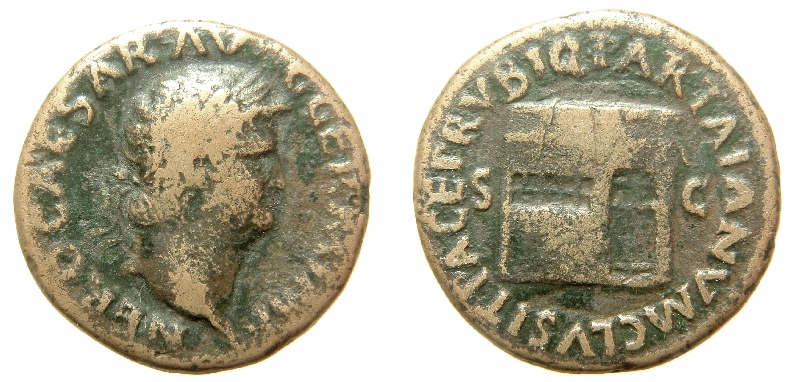
The Doors of the Temple of Janus are shut.

Nero 54-68 AD
AE as
Obv "NERO CAESAR AVG GERM IMP"
Bare bust right
Rev "PACE P R VBIQ PARTA IANVM CLVSIT SC"
Temple of Janus with doors closed
Rome mint
RIC 306
There is a series of well known sestertii, dopondii and asses issued by Nero that show the Temple of Janus with closed doors. It is also widely known that the closing of the door was symbolic of peace throughout the Roman Empire. But, what is not widely known is why the doors being shut came to represent peace........


Hill's Monuments of Rome as Coin Types (1989) offers some suggestions as to where the temple was located but does not provide an answer to our question. Similarly Stevenson's Dictionary of Roman Coins (1889) can offer us that Livy tells us that the doors were mostly open, in fact were shut only once, from the foundation of Rome to the battle of Actium, but again not why they should be shut. Suetonius reckons that Nero's closing was the third occasion on which the doors were shut.


The answer, however, does appear in Donaldson's Architectura Numismatica (1859). In it he tells us that, according to legend, the original Temple of Janus was built by either Quirinus or Romulus. He notes that, according to the ancient writer Macrobius, during the Sabine wars the enemy were rushing into Rome through the Porta Janualis when they were overwhelmed by a vast torrent of boiling water which impetuously flowed from the Temple of Janus. From then it was decreed that as Janus had come to their help during a time of war the doors should remain open.

Saturday, 6 June 2009

A handful of spits


Ionia - Klazomenai
AR obol
c.520-480 BC
Forepart of a winged boar right
Quadripartite incuse square

When I first read that in Seaford's "Money and the Early Greek Mind" I have to admit I had the wrong end of the stick! I now know the "spits" referred to were made of iron and were of the type used for roasting meat.

You see a "spit", or "obelos", gave its name to the small Greek silver coin we know as the obol. Given that small change could be carried in the mouth then my misunderstanding was, I think, excusable.

The term "drachma" means handful, particularly six (as noted by Aristotle, for example), and so we get "obeliskon drachmai" - a handful of spits - being used in temple inventories and inscriptions. These must be referring to bundles of iron rods, not the grudging payment in the hand of small silver coins. It was only later that these two terms began to have a specific reference to money.

Friday, 29 May 2009

Ancus Marcius


One of the coins in my posting about the Aqua Marcia featured on the obverse a portrait of Ancus Marcius. The coin is reposted above and I just wanted expand a little on who he was.

He was, traditionally, the fourth king of Rome, 642-616 BC; Romulus, Numa Pompilius (the maternal grandfather of Ancus Marcius) and Tullus Hostilius preceeding him.

The concept of a 'just' war is ascribed to Marcius. In a ritual, still practiced in a modified fashion in the second century AD, war was formally declared on another country only after a Roman priest had visited the territory, calling on each person he met and Jupiter himself, to witness that satisfaction was demanded in the name of religion and justice.

He also built an early prison, which was founded in around 625 BC, and was used to hold people until it was decided what to do with them or unishments they should serve. Before this time a popular punishment was to simply exile people.

Lucius Tarquinius Priscus, 616-579 BC, succeeded him as king. Well respected he was adopted by Ancus Marcius as his son, also appointing him guardian of his other sons. After the death of Ancus Marcius, Tarquinius Priscus was able to convince the People's Assembly that he should be elected king over Marcius' natural sons.

Thursday, 21 May 2009

So where was/is Abila?


A pertinent question I thought. Abila is now known as Tel Abil and it is located to the east of lake Tiberias (the Sea of Galilee), some way north of Aelia Capitolina (Jerusalem) and the Dead Sea.


It possibly formed part of an unofficial alliance of 'ten cities' from around the time of Pompey, although just how loose this grouping is can be witnessed from the disagreement over which ten cities actually constituted the Decapolis.


Pliny the Elder lists Damascus, Canatha, Scythopolis, Pella, Gadara, Hippus, Dium, Philadelphia, Gerasa and Raphana - but not Abila! An inscription dating to 133/4 AD however names the city 'Abila of the Decapolis'.

Tuesday, 19 May 2009

An unpublished coin of Abila?


FORVM recently offered this unidentified coin for sale. Given that there was enough of the obverse legend to identify it as a coin of Geta Caesar and there was a substantial amount of the reverse legend visible I figured it must be worth the $22 they were asking as it ought to be identifiable.

The left hand side of the reverse clearly reads SELEVKI in Greek letters, whilst the right reads A ABIL.... It has to be a coin of Abila in the Arabian Decapolis.

The only problem is that there is no coin of Geta listed in the appropriate British Museum Catalogue of Greek Coins for the region, nor is it listed in Spijkerman 'The Coins of the Decapolis and Provincia Arabia'. Lindgren I and III list no such con and neither do the British SNG volumes. It is also not represented in the American Numismatic Society SNG volume.

It would appear that this is a new coin of Abila, previously unrecorded.