Wednesday, 5 May 2010

Seleucia ad Tigrim

I recently came across this small bronze in a group of coins purchased for stock. I don’t normally do much with Greek coinage but it looked interesting and easy enough to identify.

It turns out to be a coin assigned to a mint at Seleucia ad Tigrim (a different city called Seleucia to the previous post), although the city ethnic does not appear on the coin the authorities appear to be confident over that part of the attribution, but from what date?

Ostensibly the coin bears a date of 224 but how does that translate to our own era? In a footnote to BMC (Greek) Parthia from 1903 there is the suggestion that if this is the Seleucid era it should be 89/8 BC, however the character of the coin may mean that it is later in date and uses a local dating era. An earlier misreading gave these coins a date of 324 in the Seleucid era, clearly in error, and there was speculation of them being issued at a time when the city was in revolt.

BMC (Greek) Mesopotamia from 1922, in which the coin is actually catalogued, again has this speculation but is no further on with a date attribution.

The coin is available for purchase by either following the link on the top left (although people using Firefox as a browser may experience some difficulty logging in) or may be reserved by expressing an interest in a comment to this post.

Saturday, 17 April 2010

Gallienus from Seleucia


I have a passion for the provincial coins and this one just came my way as an unidentified coin of Macrinus (217-8) when it is, in reality, a coin of Gallienus (253-68). The mint city is Seleucia ad Calycadnum in Cilicia.

Obverse: AV K Π ΛK ΓAΛΛIHNOC, draped, cuirassed and laureate bust right, seen from behind

Reverse: CEΛEVKEΩN KAΛVKAΔNΩ, Athena stg. right, shield in left hand, stabbing with spear a Giant with snakelike feet, who kneels before her; he grabs her spear with left hand and has a rock in his raised right hand. Rare.

The reverse shows a scene of the Gigantomachia. After Zeus has locked up the Titans in the Tartaros, Gaia sets her sons, the Giants, on the Olympic gods. They are human shaped with snakelike feet. The battle occurred at Phlegra. The Giants throw rocks and mountains. They couldn't be killed by gods, only by humans. So Herakles came into play. He shot a poisoned arrow on Alkyoneus and dragged him over the frontier where he died. Athena threw the island of Sicily on another Giant, where he was buried. His fire breathing comes out of the volcano, Mount Etna, until today.

Seleucia ad Calycadnum is located a few miles from the mouth of the Calycadnus river in south-central Mersin province of Turkey, 80 km (50 mi) west of the city of Mersin. It is now known as Silifke.

Sunday, 11 April 2010

An almost perfect coin of Aurelian....

I want to feature here a coin that is almost perfect, a beautifully detailed coin of the Roman emperor Aurelian (270-5AD). It will also give me the opportunity to correct a slight error in the catalogue reference number in the sales description (mea culpa!).
Silvered antoninianus, RIC V 254, MIR (Göbl) 225c1 (not c2 as I list in the sales description)

Siscia mint, obverse IMP C AVRELIANVS AVG, radiate and cuirassed bust right; reverse ORIENS AVG, Sol standing left holding globe in left and raising right, right foot on captive, second captive to right, * in left field, P in exergue


This is a truly superb coin with well detailed features, every fleck of hair and detail on the emperor's cuirass (armour) is evident. Click on the picture for an enlarged version to enhance the detail.. It also retains the full silver coating of the period.

These coins are about 5% silver, the remaining metal composition being bronze. The imiscibility, or "unmixability" of copper (the major constituent of bronze) and silver was exploited by the Romans to produce coins that looked like silver when they were new but soon betrayed their base metal core.

This coin can be purchased, guaranteed for a lifetime as genuine, by following the link at the top left of this page.

Sunday, 4 April 2010

An update to the origins of Mauseus

I had always assumed that the name "Mauseus", as part of Carausius' names, had come from Germanic or Britannic origins but that may not be the case. In the new Numismatic Chronicle (volume 169, 2009) there is the latest in a series of papers by Richard Ashton on the ancient coins of Rhodes. This particular paper is about a specific series of bronze coins that have the name of an official on "Mousais". Could it be that the origins are much further south and derive from the Greek?

Wednesday, 24 March 2010

Why mauseus......

I met a couple of aquaintences from the US in the flesh the other week when they visited York and one of them asked me "why Mauseus?".

I am a student of the Roman usurper Carausius (287-93AD) who took Britain away from Roman control temporarily. My avatar is his portrait, taken from a base silver coin of the reign. Mauseus is one version or reconstruction of one of his names, Marcus Aurelius Mauseus Carausius. There are other spellings or reconstructions of that part of his name.
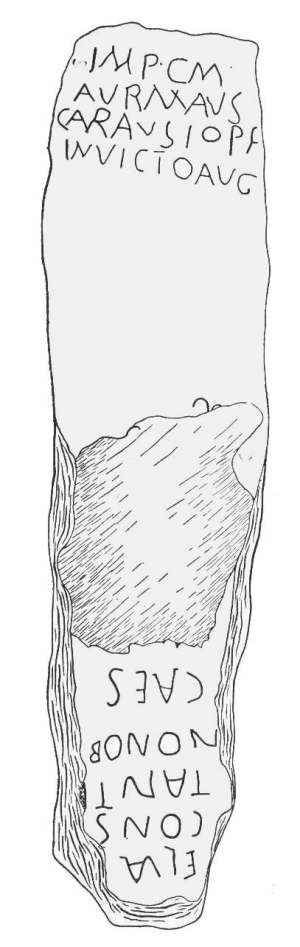
On the coins it rarely appears in any form and I don't think I've seen anything other than the initial M. The reconstruction comes from the single piece of known epigraphy from the reign, a milestone from Old Penrith (RIB 2290-2), that expands it as far as MAVS.
We are lucky for this to survive as the milestone was reused after Britain was retaken and a Constantius I inscription was put on the opposite end, the Carausius end being buried. There is an erased inscription on the middle and this is probably from the reign of another rebble, Allectus, who succeeded Carausius and represents the only known potential inscription of that reign (erased because it would still be visible in the stones upended state).

Friday, 26 February 2010

The entry of Constantius II into Rome in 356AD

Constantius II, AE maiorina, Siscia mint, RIC VIII Siscia 257

Roman coins of the fourth century AD take on a rather uniform and quite stylised approach to portraiture where the individual features of the emperor can be lost. They almost become caricatures with quite staring, cold eyes. Expressionless!

I then came across a passage in the writings of Ammianus Marcellinus, the historian who wrote an imperial history from Nerva in the first century through to the late fourth century, of an imperial visit of Constantius to Rome in 356 AD which certainly made me look at the imperial image, as presented on the coins, in a different way.

"As he (Constantius) approached the city he let his eye dwell without expression on the senators paying their humble duty and the venerable images of the patrician families"

And continues:

"The emperor was greeted with welcoming cheers, which were echoed from the hills and river banks, but in spite of the din he exhibited no emotion, but kept the same impassive air as he commonly wore before his subjects in the provinces. Though he was very short he stooped when he passed under a high gate; otherwise he was like a dummy, gazing straight before him as if his head were in a vice and turning neither to right nor left. When a wheel jolted he did not nod, and at no point was he seen to spit or to wipe or rub his face or nose or to move his hand. All this was no doubt affectation, but he gave other evidence too in his personal life of an unusual degree of self control, which one was given to believe belonged to him alone"

Constantius II, AE maiorina, Siscia mint, RIC VIII Siscia 251

Tuesday, 23 February 2010

Two Saxon penny fragments

I recently photographed and posted a message on FORVM (site link left) about a Saxon penny I have of king Edgar. At the same time I photographed two other penny fragments in my posession.
The first coin is of Burgred of Mercia made by the moneyer CENRED (the remnants of his name "....ENRED" can be seen across the centre of the reverse).

Burgred ruled Mercia between 852 and 874 and was successful in a campaign to subdue northern Wales. However, it was a period of Danish raids and he had to appeal to the kings of Wessex, Ethelred and Ethelred's brother Alfred (the Great). Unfortunately the Danes managed to drive Burgred from his kindom and he fled to Rome where he spent the remainder of his life, and was buried, according to the Anglo Saxon Chronicle, in the church of Sancta Maria in the "eternal city".
The second coin is one of Ethelred, 865-71, much scarcer than the Burgred coin, made by the moneyer Manninc (and again "MANN......" can be seen across the centre of the reverse). The portrait side of the coin also exhibits the Saxon D for the letters TH as the king's name "AEDELR....." runs around the top of the coin. He was killed at the battle of Merton, 23 April 871, one of eight battles he fought that year against the Danes.

The site of the battle is unknown. Suggestions include the borders of the London Borough of Merton, Merton in Oxfordshire, Marden in Wiltshire or Martin in Dorset. The more westerly locations tend to be favoured because King Ethelred was buried in Wimborne Minster in Dorset shortly afterwards.

A further and more likely location for the battle is Merriton, on the banks of the River Stour, a few miles downstream of Wimborne, thus providing a simple journey by barge with the body of King Ethelred. The medieval manor of Merriton was situated on what is now the southern perimeter of Bournemouth (Hurn) Airport.

Given the links between the two kindoms it is perhaps not surprising that the design of the two coins is similar