Saturday, 23 January 2016
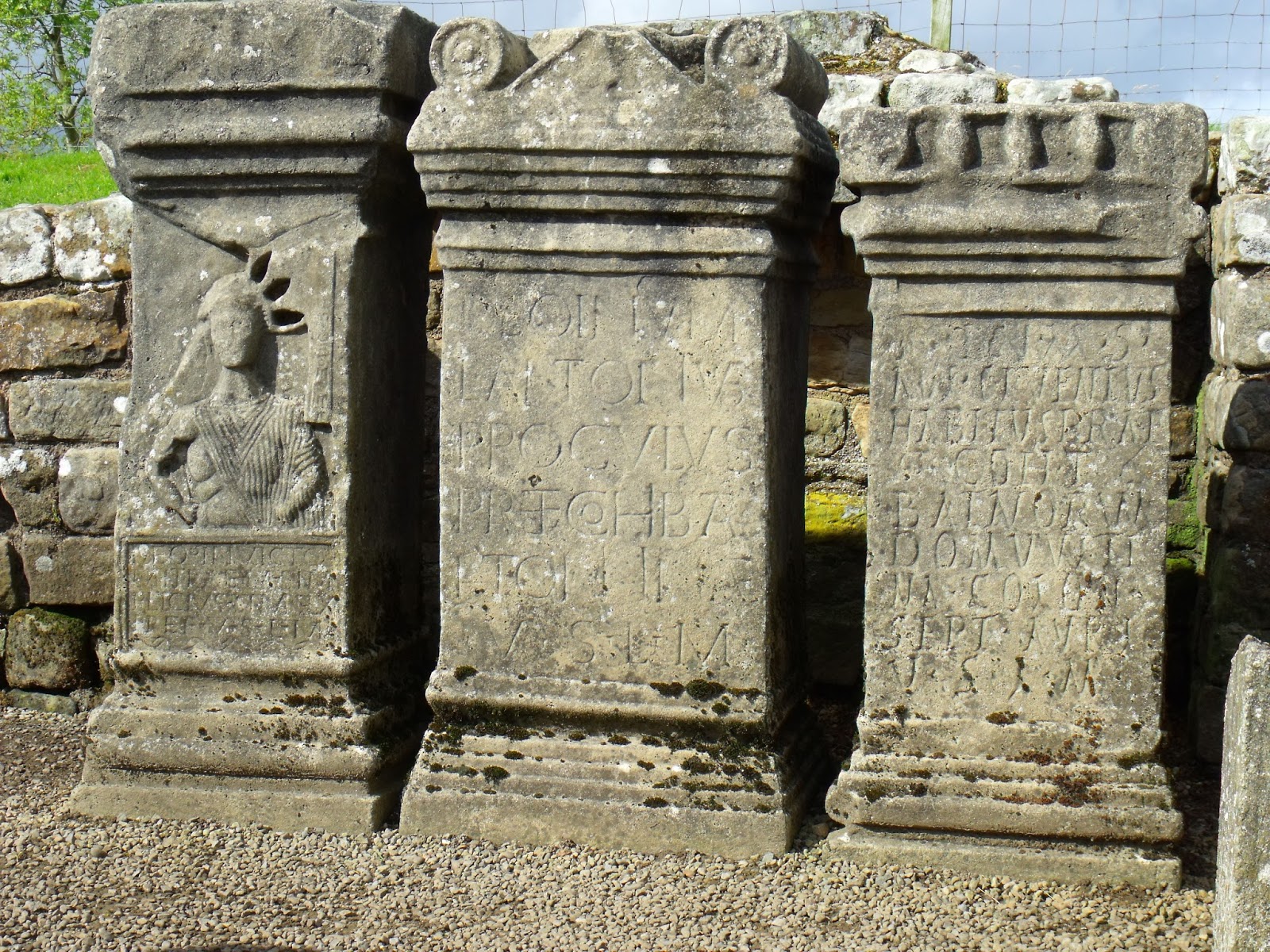
The Mithreum at Carrawburgh
I had the opportunity this weekend to visit the temple dedicated to Mithras on Hadrian’s Wall behind the auxiliary fort of Brocolita at Carrawburgh, Northumberland.
The remains of an early 3rd century mithraeum was discovered in 1949 and excavated by Ian Richmond and J.P. Gillam in 1950, and is the second-most northernly mithraeum discovered so far. The Brocolitia mithraeum is also the only sanctuary outside the Rhine provinces from which a monument of the goddess Vagdavercustis has been recovered. Like most other mithraea, the Brocolitia temple was built to resemble a cave, and also had the usual anteroom, and a nave with raised benches (podia) along the sides. At Brocolitia, the anteroom and nave were separated by a wattle-work screen, the base of which was found exceptionally well preserved.
The three altars found there were all dedicated by commanding officers of the unit stationed here, the First Cohort of Batavians, a Germanic people from the Rhineland. From left to right in the picture the named commanders are Marcus Simplicius Simplex (RIB 1546), Lucius Antonius Proculus (RIB 1544) and Aulus Cluentius Habitius (RIB 1545).
Mithraism is a Persian religion, with many aspects similar to another minor eastern Roman religion, Christianity, where the proponents are given the hope of a better afterlife rather than improving the current life and through this became a favourite of the Roman army.
Monday, 18 January 2016
The Roman mosaic from Well
On my recent visit to Masham I had the opportunity to
photograph a Roman mosaic that I had wanted to see for a long time, but for one
reason or another never had. The pavement fragment from a villa and bath house complex
is located in the church in the nearby village of Well.
The corner fragment of mosaic that is preserved features
various classic designs of both guilloche and latchkey for the border and a
central geometric design that imitates cubes in 3d. It dates presumably from
the third or perhaps fourth century AD.
Sunday, 10 January 2016
The Temple of Aphrodite, Paphos, Cyprus
AE19mm, Augustus, Paphos, RPC I 3906
It’s been a long time since I visited the temple of Aphrodite at Palaeo Paphos, also known as Kouklia, on the island Cyprus, so much so that I can’t find the photographs that I took (back in October 2000). However a recent coin acquisition has taken me back there.The coin, of the emperor Augustus from the island of Cyprus, features the temple as its reverse design with, at its centre, the conical meteoric stone that was the main feature of devotion at the temple site.
The Histories of Tacitus record a visit by the emperor Titus to the site in the first century AD:
“While he was in Cyprus, he (Titus) was overtaken by a desire to visit and examine the temple of Paphian Venus, which was famous both among natives and strangers. It may not prove a wearisome digression to discuss briefly the origin of this cult, the temple ritual, and the form under which the goddess is worshipped, for she is not so represented elsewhere.
The founder of the temple, according to ancient tradition, was King Aerias. Some, however, say that this was the name of the goddess herself. A more recent tradition reports that the temple was consecrated by Cinyras, and that the goddess herself after she sprang from the sea, was wafted hither; but that the science and method of divination were imported from abroad by the Cilician Tamiras, and so it was agreed that the descendants of both Tamiras and Cinyras should preside over the sacred rites. It is also said that in a later time the foreigners gave up the craft that they had introduced, that the royal family might have some prerogative over foreign stock. Only a descendant of Cinyras is now consulted as priest. Such victims are accepted as the individual vows, but male ones are preferred. The greatest confidence is put in the entrails of kids. Blood may not be shed upon the altar, but offering is made only with prayers and pure fire. The altar is never wet by any rain, although it is in the open air. The representation of the goddess is not in human form, but it is a circular mass that is broader at the base and rises like a turning-post to a small circumference at the top”
Another interesting feature of the coin is that the reverse bears the name A Plautius, Proconsul. Michael Grant, in his book ‘From Imperium to Auctoritas’, suggests that this may be the father of Aulus Plautius, the conqueror of Britain and first governor of the province in 43 AD, leading his invasion in support of Verica, king of the Atrebates and an ally of Rome, who had been deposed by his eastern neighbours the Catuvellauni.
Saturday, 2 January 2016
A Vampire near Masham
Driving up a small valley outside of Masham in North Yorkshire the other day I came across a pair of severed wings with RAF roundels painted on them. I was curious as to the aeroplane type that had originally had them fitted so I grabbed a quick photograph.
I initially thought of a Canberra or perhaps a Meteor, however the curved fairing under the wing was wrong, plus the wheels on both of those aircraft point towards the fuselage whereas on these wings they point away. Then it came to me, the de Havilland Vampire. Sure enough the wheel alignment was correct and the visible fairing on the wing is from the tail boom.
Sunday, 20 December 2015
A small obol from Neandreia
I have a perverse pleasure in very small Greek silver coins, the smaller the better. I happened across this one and, whilst I already had an example of it, the state of preservation of this one made me buy it. On a coin only 7mm and weighing in at only 0.4 grammes the artistry of the head of Apollo on one side combined with the goat on the other make this a thing of wonder.
It is a silver obol from the city of Neandreia in the Troas in Anatollia, Turkey, dating from around 400 BC.
We do not know the circumstances of Neandreia's foundation in the Archaic period. A tradition known to the author of the 4th century CE work Dictys Cretensis Ephemeridos belli Trojani claimed that Neandreia had been the home of the legendary king Cycnus who was killed on the first day of the Trojan War by Achilles and his city sacked.
In the 5th century BCE Neandreia was a member of the Delian League and is recorded paying a tribute to Athens of 2,000 drachmas as part of the Hellespontine district from 454 to 410 BC. Soon after this latter date, perhaps following the defeat of Athens in the Peloponnesian War in 404, the city of Neandreia came under the influence of Zenis, the dynast of Dardanus, who controlled the Troad on behalf of the Persian satrap Pharnabazos.
Monday, 12 October 2015
Two new Beatles mixes from Revolver on acetate
The song Taxman by George Harrison opened the 1966 album Revolver. The version that appeared there was take 12 recorded/mixed 20–22 April, 16 May and 21 June 1966. It featured an ending that was made up of an overdub of the McCartney guitar solo from the middle eight. The album of alternate versions, Anthology 2 (released 1996), featured a version that ended “cold” with the word “Taxman”.
Recently a version has surfaced on an Emidisc acetate from 1966 that bridges these two versions in that there is an extended ending of an overdub, not of the middle eight guitar solo but with the driving bass riff that underpins the song (and that was incidentally used by the Jam on their song Start! From the album Sound Affects).
It came in a group of acetates that also included a new rough mix of And Your Bird Can Sing with a shaky lead guitar track and different drumming in the outro, also from Revolver.
Recently a version has surfaced on an Emidisc acetate from 1966 that bridges these two versions in that there is an extended ending of an overdub, not of the middle eight guitar solo but with the driving bass riff that underpins the song (and that was incidentally used by the Jam on their song Start! From the album Sound Affects).
It came in a group of acetates that also included a new rough mix of And Your Bird Can Sing with a shaky lead guitar track and different drumming in the outro, also from Revolver.
Monday, 5 October 2015
Cunobelin
Bronze coins of Cunobelin
Cunobeline (or Cunobelin, from Latin Cunobelinus, derived from Greek Kynobellinus) was a king in pre-Roman Britain from the late first century BC until the 40s AD. He is mentioned in passing by the classical historians Suetonius and Dio Cassius, and many coins bearing his inscription have been found. He appears to have controlled a substantial portion of south-eastern Britain, and is called "King of the Britons" (Britannorum rex) by Suetonius.
Cunobeline appears in British legend as Cynfelyn (Welsh), Kymbelinus (medieval Latin) or Cymbeline, as in the play by William Shakespeare. His name is a compound made up of cuno- (hound) and Belenos (the god Belenus).
From numismatic evidence Cunobelinus appears to have taken power around 9 AD, minting coins from both Camulodunum (Colchester, capital of the Trinovantes) and Verlamion (later the Roman town of Verulamium, now modern St Albans), capital of the Catuvellauni. Some of the Verulamium coins name him as the son of Tasciovanus, a previous king of the Catuvellauni; unlike his father's, his coins name no co-rulers. However his earliest issues are from Camulodunum, indicating that he took power there first, and some have a palm or laurel wreath design, a motif borrowed from the Romans indicating a military victory. He may have been emboldened to act against the Trinovantes by the Roman defeat in the Battle of the Teutoburg Forest in Germania in AD 9. The Trinovantes were a Roman ally whose independence was protected by a treaty made by Julius Caesar in 54 BC, but problems in Germania severely discouraged Augustus's territorial ambitions and ability to defend allies in Britain.
Cunobelinus appears to have maintained quite good relations with the Roman Empire. He used the title Rex (Latin "king") and classical motifs on his coins, and his reign saw an increase in trade with the continent. Archaeology shows an increase in luxury goods imported from the continent, including Italian wine and drinking vessels, olive oil and fish sauces from Hispania, glassware, jewellery and Gallo-Belgic tableware, which from their distribution appear to have entered Britain via the port of Camulodunum. He was probably one of the British kings that Strabo says sent embassies to Augustus. Strabo reports Rome's lucrative trade with Britain: the island's exports included grain, gold, silver, iron, hides, slaves and hunting dogs.
Cunobelinus had three sons, Adminius, Togodumnus and Caratacus, and a brother, Epaticcus, known to history. Epaticcus expanded his influence into the territory of the Atrebates in the early 20s AD, taking the Atrebatan capital Calleva (Silchester) by about 25. He continued to expand his territory until his death in about 35, when Caratacus took over from him and the Atrebates recovered some of their territory.
Adminius, judging by his coins, had control of Kent by this time. Suetonius tells us that in ca. 40 he was banished from Britain by his father and sought refuge with the emperor Caligula; Caligula treated this as if the entire island had submitted to him. Caligula prepared an invasion of Britain, but abandoned it in farcical circumstances, ordering his soldiers to attack the waves and gather seashells as the spoils of victory.
Cunobelinus died some time before 43. The Lexden Tumulus on the outskirts of Colchester has been suggested as his tomb (although the earlier Trinovantian king Addedomarus is another candidate for its occupant). Caratacus completed the conquest of the Atrebates, and their king, Verica, fled to Rome, providing the new emperor, Claudius, with a pretext for the conquest of Britain. Caratacus and Togodumnus led the initial resistance to the invasion. Dio Cassius tells us that the "Bodunni", a tribe who were tributary to the Catuvellauni, changed sides and supported the Romans. This is probably a misspelling of the Dobunni of Gloucestershire, indicating that Cunobelinus's hegemony extended as far as the West Country.
Subscribe to:
Posts (Atom)