Wednesday, 20 May 2020
The last "supermoon" of 2020
Finally got around to downloading this image of the Moon, taken by me on 6th May 2020. It was a so-called a "supermoon", the third and final one of 2020. The term supermoon is used to refer to a full Moon on its closest passage to the Earth, or at lest within 90% of its closest passage.
What this means is that this passage was within 224,429 miles (361,184 km)
Thursday, 30 April 2020
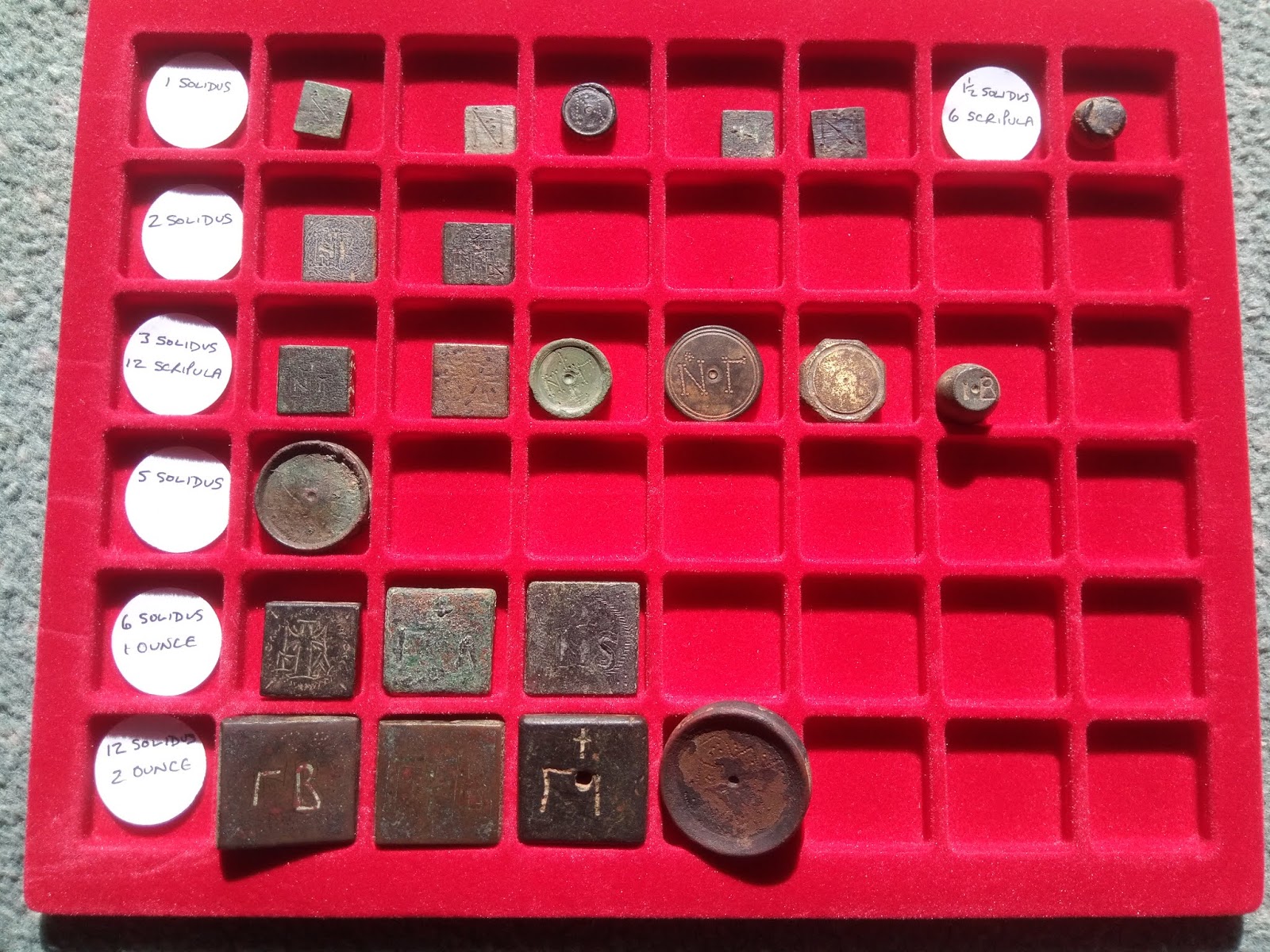
Late Roman / early Byzantine weights
I first posted on the weighing of late Roman and early Byzantine coins in May 2018. This post is an update on my collection of weights from the period. The weights are either marked on nomismata (solidi), scripula grammata or ounces. The design either engraved or punched in , sometimes quite shallow and at times is enhanced by silver inlay.
There is overlap between commercial weights and the coin weights. Although I don't have an example there are some weights known marked with both the weight in solidi and ounces.
1 ounce = 6 solidi = 24 scripula
Thursday, 16 April 2020
Machine Tokens update
Thursday, 26 March 2020
Machine token collection
This collection started as the product of a mis-spent youth, venturing into paranumismatics! A work in progress during these times of curfew, keeping me well and for the best. I have started some Web pages with my collection of slot machine tokens.
https://machinetokens.blogspot.com/
Probably only 10% of the collection listed so far but I'm working on it. Would be happy to hear from other collectors of this series.
https://machinetokens.blogspot.com/
Probably only 10% of the collection listed so far but I'm working on it. Would be happy to hear from other collectors of this series.
Sunday, 5 May 2019
Pythagoras and early Italian coinage
The early Italian coinage from the instep of the "boot" of Italy is very distinct. The reverses frequently mirror the obverses but incuse, rather than relief. Dating to the period c. 530-510 BC four of the obove five coins show this trait.
The top two are from Sybaris, the middle coin from Croton and the bottom two from Metapontum.
The question arises why the distinctive relief/in use mirrored design? It has been suggested that it aids the stacking of the coins. That hypothesis doesn't really stand as, unless the sided of the coin are identical, they won't interlink. With hand made dies/punches this is not possible.
One of the more intriguing suggestions is that their introduction is linked to the exile of Pythagoras from Samos. His father was a gem engraver and the skills of a coin die engraver are very similar. Pythagoras was exiled initially to Croton and then Metapontum around 530 BC and so the approximate timings are right. It is a possibility that this individual was responsible for the introduction of the distinctive coin design.
Friday, 1 March 2019
Europa and Zeus
Tiberius, AE 20mm, Amphipolis in Macedon, Europa riding astride a bull (Zeus)
On a beach in Sidon a bull was aping a lover’s coo. It was Zeus. He shuddered, the way he did when a gadfly got him. But this time it was a sweet shuddering. Eros was lifting a girl onto his back: Europa. Then the white beast dived into the sea, his majestic body rising just far enough above the water to keep the girl from getting wet.........Trembling Europa hung on to one of the bull’s long horns. Boreas spotted them as they ploughed through the waves.
Europa could see no end to this crazy sea crossing. She guessed what would happen to her when they hit land again. And she shouted to the wind and water: “Tell my father that Europa has been carried off by a bull – my kidnapper, my sailor, my future bedmate, I imagine.” She was going to call to Boreas too, ask him to lift her up on his wings, the way he’d done with his own bride, Oreithyia, from Athens. But she bit her tongue: why swap one abductor for another?
Augustus, AE 20mm, Amphipolis in Macedon, Europa riding astride a bull (Zeus)
Monday, 10 December 2018
Lawrence Wilson, Wetherby 1667 token issuer
I am not a token collector but I have always been interested in the nearest 17th century tokens issued to where I have spent most of my life.
There was a monetary crisis in the mid 17th century, silver was not issued in the form of farthings nor half pennies because their size was prohibitively small. There was an attempt by the government at the time to rectify it with the issue of patents to Harrington and Lennox for the production of base metal coinage but this had ceased by 1650 and, in order to facilitate small trade local merchants issued their own base metal tokens.
I have just been lucky enough to acquire, albeit a poor example, the rare 1667 token from Wetherby issued by Lawrence Wilson (pictured at the head of this post).
Obv: (star)LAWRENCEWILSON.HIS.HALFE , around beaded inner circle, shield containing Blacksmith's Arms within.
Rev: (star)PENNYOF.WEATHERBE.1667 , around beaded inner circle, L W with ormonde knot below, at the ends of which three flowers appear above the initials.
Williamson 365
The memorial gardens, Wetherby
There was a pub in Wetherby called the Blacksmiths Arms, located where the memorial gardens are, adjacent the HSBC bank opposite the Horsefair Centre. It was noted in the 1834 trade directory in the possession of James Mason and was finally recorded as closing in 1929.
Williamson's catalogue of 17th century tokens
The three Wetherby tokens
Subscribe to:
Posts (Atom)