Saturday, 16 April 2022
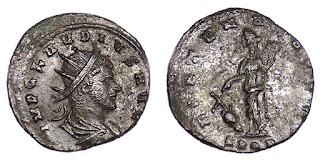
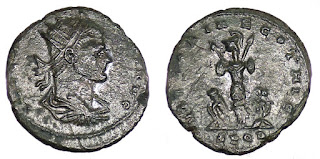
The last Roman aes from Trier (well almost)
Sunday, 10 April 2022
A twelve labours denarius of Postumus
POSTVMVS PIVS FELIX AVG
Laureate, cuirassed bust of Postumus with bust of Hercules, jugate, right
HERCVLI NEMAEO
Hercules facing left wrestling Nemean lion
Mint 1 (Trier), Schulte group 11a
Schulte 122, RIC 349, Elmer 523
Schulte records a number of aurei and denarii of Postumus with the bust jugate with Hercules on the obverse. However, the coins of Schulte’s 11th group are of particular interest. In this group there are a series of reverse types that depict some of the twelve labours of Hercules.
Schulte’s 11th group is dated to AD268 and is associated with the fourth consulate of Postumus and the beginning of his decennalia celebrations, but why the association with the labours? It has been suggested that this special group of coins marks the conclusion of a struggle and it may be no coincidence that Postumus inflicted a defeat on Gallienus at this time. In this defeat we learn from the ancient writer Zonaras that Gallienus was significantly wounded, being struck by an arrow in the back.
To support this theory there is, in Schulte’s 11th group, a denarius that combines the Postumus and Hercules jugate bust with the PAX AVG reverse from antoninianus dies, suggesting a period of tranquility was occurring.
Furthermore, in the antoninianus coinage, besides the usual right facing, radiate, draped and cuirassed bust of the emperor on the obverse Postumus also uses a special, rare, left facing die. A radiate, draped and cuirassed but of the emperor is augmented with the club of Hercules over the emperor’s right shoulder and the skin of the Nemean lion adorning the left, again hinting that the trials are over.
The Herculian labours coins are all of the greatest rarity. The superb Thys collection of Gallic coins was lucky enough to have four of the labours denarii, but not the Nemean lion type. In Schulte type 122 is represented by only a single example (British museum, ex de Salis, Sparkes and Dupree collections), making this piece probably only the second recorded example.
Further reading:
Schulte, B; Die Goldpragung der gallischen Kaiser von Postumus bis Tetricus, 1983
Thys collection, Jacquier auction 42, 16 September 2016
Wednesday, 6 April 2022
Tetricus I, confirmation of the SALVS AVG type
Anyone who follows Roman Imperial Coinage (RIC) for the antoninianus coinage of the Gallic Empire will be sadly misguided . What you really need to familiarise yourself with are the hoard reports from the western provinces, Markus Weder’s two SNR papers correcting Schulzki’s AGK and Jerome Mairat’s PhD thesis.
One example is the Salus coinage of Tetricus I. From the literature we find that there are two reverse variants that predominate, both from mint 1 with the draped and cuirassed bust; SALVS AVGG with Salus feeding a serpent rising from an altar holding a tall rudder (Elmer 779) and SALV_S AVGG with Salus feeding a serpent rising from an altar holding a short rudder (Elmer 788) .
Although RIC 121 suggests that SALVS AVG Salus feeding a serpent rising from an altar whilst holding a vertical sceptre is a common type it is rather unusual . Elmer lists the type (Elmer 776), but examination of the plated coin, missing most of the emperor’s name is a coin of Victorinus looking at the portrait style. The same conclusion has to be reached for a coin sold through the CGB Web shop and listed on acsearch.info. Schulzki included the type in AGK, number 19a, although Weder was unable to find an example and concluded that the type probably did not exist. This coin, iilustrated at the top of the note and seemingly from official dies, confirms the existence of the type.
Rare examples have been noted pairing the DIVO VICTORINO PIO obverse with the SALVS AVG reverse, Mairat notes four occurrences and illustrates the two British Museum specimens. It important from a mint attribution point of view as the consecration coinage for Victorinus was seen as a Mint 2 product because of the pairing with the Victorinus lifetime reverse of PROVIDENTIA AVG, but SALVS AVG is a Mint 1 type for him.
The late use of a probable Victorinus reverse die combined with a Tetricus senior obverse is unusual. One might expect the Deified Victorinus coins to be produced at the beginning of the reign of Tetricus and so the potential for dies to get mixed up. However, on this coin, with the obverse legend IMP C TETRICVS P F AVG, it has to be produced after the legend contraction removing the praenomen Esuvius.
It is not noted in any of the Coin Hoards of Roman Britain (CHRB) hoard reports, including the large finds like Cunetio, Normanby etc.
References:
Besley, E, and Bland, R; The Cunetio Treasure, 1983
Elmer, G; "Die munzpragung der Gallischen kaiser in Koln, Trier und Mailand" Bonner Jahrbuch 146, 1941
Mairat, J; The Coinage of the Gallic Empire, PhD Oxford, 2014
Schulzki, H-J; Die Antoninianpragung der Gallischen Kaiser von Postumus bis Tetricus (AGK), 1996
Webb, P. H; Roman Imperial Coinage 5 (part 2), 1933
Weder, M; "Munzen und munzstatten der gallisch-romischen kaiser" Schweizerische Numismatische Rundschau 76, 1997 and 77, 1998
Saturday, 1 January 2022
The demise of a Yorkshire token issuer
Visited Scarborough the other day. Sad to see the Luna Park funfair site empty, but hopefully it is only temporary. Apparently the Tuby family who ran it for years have given it up and the lease had now been taken over by another company who plan to revamp it. I don't know if they will retain the name so posting here along with a couple of slot machine tokens known from there, given their size they are presumably 10p tokens from the 1970s, information seems scant.
Monday, 20 December 2021
The SPQR mint(s) of Gallienus and Claudius II
The latter
half of the third century saw the number of Roman mints beginning to expand,
and, at the same time, the number of mints striking the civic coins go into
rapid decline. The new mints are usually not named on the coins and we need to
use find spots and style to propose mint locations.
It is
against this background that we see a series of coins beginning late in the
reign of Gallienus and continuing into Claudius II marked with SPQR on the
reverse.
RIC is of
little help here in that it gives them to “Asia” under Gallienus, perhaps
Antioch as pellets on the obverse are sometimes seen under the bust on the
obverse, similar to the Antioch coinage of Trebonianus Gallus. For Claudius II
it places them at Cyzicus, recognising that the later coins marked MC are
stylistically similar.
In 1975 a
paper in the British journal, Numismatic Chronicle, recognised that the SPQR
series under Gallienus may be Cyzicus, but the author suggested that all the
Asian sole reign coins of Gallienus were from the same location, eliminating
Antioch as a mint from the time.
Gysen proposed
an arrangement that agreed that the SPQR coins were ultimately produced at Cyzicus,
but the original location was Smyrna (CENB 1999). The change in location was proposed
to have taken place early in the reign of Claudius, recognised in the coinage by a first emission of unmarked coins, the
adoption of the MC mark for the second before reverting back to SPQR for the third and dropping all marks again for the fourth and final emission.
Huvelin supported
the idea that Smyrna may have been the original locus of the mint. This was based
partially on stylistic criteria, but also on the commonality of a reverse device,
an Amazon holding a bipenis, that occurred on both the civic issues from the city
and an antoninianus type of Gallienus.
Gysen’s arrangement
is not ideal, given the transition of marks, SPQR to MC to SPQR to nothing. It is
not the organisation adopted by the BnF for the cataloguing work in preparation
of the RIC revision. The SPQR coins attributed to Smyrna seem to be limited to the first emission through to early 269. After this date the establishment ceases and production transferred to
Cyzicus and there is a mixture of SPQR, MC and unmarked coins, depending on the emission.
GALLIENUS
Emission 1 ABVNDANTIA AVG (MIR 1524c) Smyrna
Emission 1 AEQVITAS AVG (MIR 1525c) Smyrna
Emission 1 CONSERVATOR AVG (MIR 1529c) Smyrna
Emission 1 VENER VICTRIX (MIR 1537c) Smyrna
Emission 2 P M TR P XVII (MIR 1540b) Smyrna
Emission 2 SALVS AVG (MIR 1547c) Smyrna
Emission ? PAX FVNDATA (unpublished) Smyrna
Emission ? VIRTVTI AVG (MIR -, RIC 676) SmyrnaCLAUDIUS II
Emission 1 VIRTVTI AVG (RIC 253, RIC temp 847) Smyrna, end 268- early 269
Emission 3 FORTVNA REDVX (RIC 238, RIC temp 953) Cyzicus, end 269 - early 270
Emission 3 PAX AETERNA (RIC 234, RIC temp 951) Cyzicus, end 269 - early 270
Elks, K; 'The eastern mints Valerian and Gallienus: the evidence of two new hoards from western Turkey' NC 7th ser, XV (1975), pp91-109
Gysen, P; 'A propos des ateliers de Smyrne et de Cyzique que sous Claude II le Gothique' CENB 36, no. 2 (1999), pp29-41
Monday, 29 November 2021
The denarii of AD 268
After AD 238 issues of the denarius were sporadic. There were two significant issues around 240 under Gordian III, one of which was associated with his marriage to Tranquilina. The next substantive release was during the penultimate series of coins of Rome mint for Gallienus, c.268. In the current literature this is often referred to as the fifth sole reign issues (for example British Museum hoard reports) or emission 9 (Robert Goebl’s Moneta Imperii Romani 36, 43, 44 volume covering the period).
The Gallienus issue is substantial, well, compared to previous issues of denarii and is probably connected to the donativa for a significant milestone event during the reign. The placement in the reign is the clue and the issue is likely concurrent with the quindeccenalia, the celebrations of the 15th anniversary of the reign. Another potential occasion is the anticipated return to Rome, after the victory against the Goths at Naissus, given the rare INT VRB sestertii and double sestertii, anonymous but with the face of Gallienus on the obverse, that also date to this period. The return never happened as Gallienus was forced to move against Aureolus, based in Milan and supporting the Gallic usurper Postumus.
The reverse types of the laureate bust denarii mirror the reverse types of the radiate antoniniani, although they do not usually feature the officina or workshop letter that is present on the radiate pieces.
The reverse types known are as follows, and it would appear that not all twelve officina are represented in the coins and this may have been the reasoning why some authors postulate that there was a transitional stage in the increase of workshops from six to twelve. So, from my trays:
Off. 1 - MARTI PACIFERO
Off. 2 - ABVNDANTIA AVG
Off. 3 - AETERNITAS AVG
Off. 4 - FECVNDITAS AVG (Salonina)
Off. 5 - VBERITAS AVG
(not represented in my collection)
Off. 6 - FORTVNA REDVX
MIR 664t
Off. 7 - VICTORIA AET
Off. 7 - ORIENS AVG
Off. 8 - SECVRIT PERPET
Off. - 9 FIDES MILITVM
Tuesday, 5 October 2021
The name of the Roman silver radiate
I suspect that if I were to pose the question “what is the
Roman coin denomination pictured above” there would be large number of
responses of “antoninianus”. Whilst this is not technically incorrect as it is
the name we now use for the coin type it is a modern sobriquet. The Roman in
the street would not recognise the term.
I do not know when the term was first applied to the radiate
third century coin, initially made of silver in the third century and
progressively debased to a nadir under Claudius II and reformed under Aurelian.
It does not appear to have been a term applied in the 18th century. Even
during the 19th century the term takes a while to become established.
Akerman in his Descriptive Catalogue of Rare and Unedited Roman
Coins (1836) does not use the term antoninianus. Neither does Humphrey in his Coin
Collectors Manual (1853) where the radiate silver coin of Caracalla is called the
argenteus.
The Handbook to Roman Coins by Madden (1861) uses the phrase
argenteus antoninianus and by the 1880s the
term antoninianus is in common usage, for example Rohde, Die Munzpragung des Kaisers
Aurelianus (1881).
So, is there any classical use of the phrase antoninianus? The
short answer is yes, however it is not in reference to the silver coin of the third
century where the emperor is shown wearing a radiate crown.
The Historia August, the ancient text that provides historical
sketches of the emperor’s in a sometimes fanciful manner does use the term antoninianus
to describe a coin of Caracalla (Marcus Aurelius Antoninus). Unfortunately that
numismatic reference is to a coin in gold. The same text also contains reference
to the philippeus, one time referring to a gold piece but several other references
are to the silver coins. There are other coin references in the text to imperial
coins and each time it is cited in the form of a coin of x, for example a saloninianus.
Hence the picture above, you might say there are four third century philippei, not antoniniani, as we are so used to calling them.