Sunday, 25 May 2025

The funeral of Septimius Severus (again)


Septimius Severus, denarius, Rome mint, RIC 191f

I have recently been gifted this wonderful Consecratio denarius of Septimius Severus with the funeral pyre reverse. It is a type I have been looking for for quite a while now and it seems to be much less frequently encountered than the alternative type of the eagle on a globe.

As the a follow on from my post “The supposed site of the cremation of Septimius Severus” (April 2024) I want to set out what the ancient historians had to say about the events, starting with the death of Severus on 4th February 211.

Herodian records in book 3, chapter 15:

[3.15.2] Considering his father, who had been ill for a long time and slow to die, a burdensome nuisance, he (Caracalla) tried to persuade the physicians to harm the old man in their treatments so that he would be rid of him more quickly. After a short time, however, Severus died, succumbing chiefly to grief, after having achieved greater glory in military affairs than any of the emperors who had preceded him.

[3.15.4] After his father’s death, Caracalla seized control and immediately began to murder everyone in the court; he killed the physicians who had refused to obey his orders to hasten the old man’s death and also murdered those men who had reared his brother and himself because they persisted in urging him to live at peace with Geta. He did not spare any of the men who had attended his father or were held in esteem by him.

[3.15.7] Since all these opposed his wishes, Caracalla, from necessity, not from choice, agreed to live with Geta in peace and friendship, but this was pretended, not sincere. Thus, with both of them managing imperial affairs with equal authority, the two youths prepared to sail from Britain and take their father’s remains to Rome. After burning his body and putting the ashes, together with perfumes, into an alabaster urn, they accompanied this urn to Rome and placed it in the sacred mausoleum of the emperors.

[3.15.8] They now crossed the Channel with the army and landed as conquerors on the opposite shore of Gaul.

There is no agreement across the ancient authors over the receptacle to carry the remains of the emperor. As well as the alabaster urn of Herodian we get a golden casket in the, often unreliable, Historia August. Cassius Dio, however, offers the suggestion of a special purple stone receptacle. 

Blue John ore 

Purple, the imperial colour, could possibly be Blue John. The Romans were mining lead, with silver as a by-product, in Derbyshire. They would have encountered Blue John and it would be a most appropriate material for the container for the remains of a deceased emperor.

On the actual return to Rome, and the associated ceremonies we can turn to Herodian, this time book 4. Picking up in May 211...

[4.1.3] When they arrived in Rome, the people welcomed them with laurel branches and the Senate, too, came out to greet them. The two youths headed the procession, wearing the imperial purple; the consuls for that year followed, carrying the urn which held the ashes of Severus. Then those who had come out to greet the young emperors passed by the urn and paid their respects to the emperor.

[4.1.4] The procession escorted the urn to the mausoleum where the remains of Marcus and his imperial predecessors are to be seen. After performing the rites prescribed for new emperors, the youths entered the imperial palace.

Continuing in Herodian book 4, chapter 2.....

[4.2.1] It is the Roman custom to elevate to divine status those emperors who at their death leave sons or designated successors; they call this honor deification. To begin with, public mourning, a combination of festive feeling and religious ceremony, is observed throughout the entire city.

[4.2.2] After a costly funeral, the body of the emperor is interred in the customary fashion. But then a wax image is fashioned in the exact likeness of the corpse and placed on a large, high couch of ivory draped with coverings embroidered with gold. This wax figure lies on the couch like a sick man, pale and wan.

[4.2.3] During most of the day people sit on each side of the couch; on the left is the entire Senate, clad in black; on the right are all the women who, because of their husbands’ or their fathers’ positions, are entitled to honor and respect. None of these women wear gold ornaments or necklaces; each affects the plain white garments associated with mourning.

[4.2.4] The various ceremonies mentioned above continue for seven days. Every day the physicians come and visit the couch; after pretending to examine the sick man, they announce daily that his condition is growing steadily worse. When it appears that he is dead, the noblest of the equestrians and picked young senators lift the couch and carry it along the Sacred Way to the Old Forum, where the Roman magistrates give up their authority.

[4.2.5] Tiers of seats are erected on each side of the couch: on one side sits a chorus of children from the noblest and most distinguished families; on the other, a chorus of women who seem to deserve respect. In honor of the dead man each choral group sings hymns and paeans arranged in solemn and mournful measures.

[4.2.6] The couch is then carried out of the city to the Field of Mars, where, in the widest part of the plain, a square building has been constructed entirely of huge wooden beams in the shape of a house.

[4.2.7] The whole interior of this building is filled with firewood; and on the outside it is decorated with gold-embroidered hangings, ivory figures, colored paintings. Upon this structure rests a smaller second story, similar in shape and decoration, with open windows and doors. And there is a third and a fourth story, each smaller than the one beneath it; finally, the smallest story of all tops this structure.

[4.2.8] The building may be compared in shape to the lighthouses along the coast which by the light of their fires bring to safety ships in distress at night. The common name for such a lighthouse is Pharos. They bring the couch to this structure and carry it up to the second story; then they add every kind of perfume and incense the earth provides, together with all the fruits, herbs, and juices that are gathered for their fragrance.

[4.2.9] Every province, every city, every man of fame and distinction is happy to furnish these last gifts in the emperor’s honor. After a huge pile of aromatic material is collected, and the structure is completely filled, a cavalry exhibition is staged around the building; the entire Equestrian cavalry circles around it, following a fixed rotating pattern in the Pyrrhic choruses and manoeuvres.

[4.2.10] Chariots, too, are driven around the building in similar formations by drivers in purple robes; these chariots carry statues whose faces are those of Romans who fought or ruled in distinguished fashion. When these rites have been completed, the emperor’s successor puts a torch to the structure, after which the people set it on fire on all sides. The flames easily and quickly consume the enormous pile of fire-wood and fragrant stuffs.

[4.2.11] From the topmost and smallest story, as if from a battlement, an eagle flies forth, soaring with the flames into the sky; the Romans believe that this eagle carries the soul of the emperor from the earth up to heaven. Thereafter the emperor is worshiped with the rest of the gods.

It is this pyre, described above, that features as the design represented on the coin type.


Sunday, 4 May 2025

The four denarius piece

I was recently involved in a discussion about a small tetrarchic laureate and the question of it's denomination and that then had me searching through my library for two days. I have been looking for a piece of paper connected with, and adding to, an inscription from Aphrodisias that was published in 1971 (Journal of Roman Studies, Erim etc al, "Diocletian's Currency Reform: A New Inscription"). Finally found it! It tells us what the Romans actually called one of their coins and its value in denarii.

The inscription is similar to the Edict of Maximum Prices but, I think, predates it. It pertains to a monetary reform part way through AD 301 that was a stepping stone to the Price Edict.

John Kent of the British Museum knew an additional portion to the fragments published in 1971, one that was un-published as far as I am aware. By supplementing the original inscription fragments with the new piece the text reads "bicharactam pecuniam.........qvae in maiore orbis partec......qvattvor denariorvm", or in other words the "bicharactam pecunia (or coin with two characters/figures on the reverse).. the coin that most of the world knows as a four denarius piece".

This shows that the radiate fraction of the period is not tariffed at five denarii as is often quoted in literature.

This reform of AD 301, documented in the Aphrodisias inscription fragments, coincided with a change in the reverse design of the nummus at Trier where the figure of Genius is replaced by Moneta, possibly a further indication of the monetary reform. 

Sadly I do not have a photograph of this fragment, however I do have a hand written note from Dr Kent's presentation, further annotated in the hand of the late John Casey.


Tuesday, 11 March 2025

The death of Constantius I Chlorus at York

Deified Constantius I, AE nummus, RIC VI (Lon 110)


Unlike the death and cremation of the Roman emperor Septimius Severus at York on the 4th February 211 very little is known about the death of Constantius I Chlorus some 95 years later. 

He did, according to the available sources, die a quiet death in his palace at York on 25 July 306. Nothing is said about his funeral or burial other than what is noted by Philostragus that his son *Constantine............ soon after committed his body to the tomb and thus became his successor". 

The extant narrative suggests that his death, burial and succession occurred in relatively quick succession, so where was the tomb of Constantius located? 

There is one curious tradition that Constantius' tomb was located on Aldwark. There are stories that it was below the church of St. Helen on the Walls and that the tomb was shown to visitors as late as the the 16th century. William Camden (Britannia, 1695) writes that he "had been informed by credible persons, that in the suppression of the monasteries in the last age, there was found a lamp burning in the vault of a little chapel here, and Constantius was thought to be buried there". The name of the church that is referenced by Camden is recorded as being that of St. Helen on the Wall by Drake (Eboracum, 1715).

The church was located adjacent to the Merchant Tailors Hall, outside of the Roman fortress walls, and was demolished around 1549/50. It was rediscovered in 1972 and subjected to archaeological investigation. Although a lot of damage had been done by post mediaeval building Roman occupation levels were identified on the site. 


Sunday, 13 October 2024

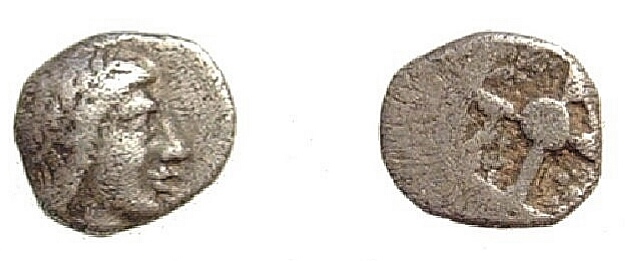
A Kolophon hemiobol reattributed to Magnesia

The ancient city of Kolophon (sometimes spelt Colophon in the literature), is located in Ionia, Asia Minor. The ruins are situated to the south of the Turkish town of Degirmendere.

The standard reference work for the ancient coins was published by J G Milne in 1941, (Kolophon and its coinage: a study, American Numismatic Society Numismatic Notes and Monographs 96). The publication date betrays the difficulties in academic pursuit and this is noted by the author in the introduction. He says that:

Before the interruption of international relations in Europe, I was collecting material for a monograph on the coinage of Kolophon: it seems improbable that I shall be able to complete it on the original plan; but it may be worth while to put on record the facts ascertained and the conclusions they suggest”.

I happened to be leafing through a 1990s Spinks Numismatic Circular report on a parcel of Ionia fractional silver coins and a Kolophon piece was the subject of a reattribution.

The type in question is a silver fraction, a hemiobol, features a right facing head described as being of Artemis on the obverse, Milne considering it to have feminine features. On the reverse there is a shallow incuse quadripartite square with a pellet in the centre. Milne lists it as a type from Kolophon from after 490 BC, number 18 in his catalogue.

The Spink paper cites a later reference that questions the Kolophon origin. Colin Kraay, in a 1962 Schweizer Numismaticshe Rundschau paper (Monnaies provenant du site de Colophon), suggests an alternative, possibly Magnesia ad Maeandrum. He puts forward the alternative based on the uncertainty of the head on the obverse, preferring an identification of it as being male and that of Apollo. He also believes that the type is too abundantly encountered for the relative unimportance of Kolophon at the time. He therefore suggests that Magnesia ad Maeandrum may be the more likely origin of the type, particularly as the city is known to have used an image of Apollo on the later coins issued by Thermistocles, c. 460 BC.

This is the difficulty when there is no city ethnic. Attributions have to be made based on criteria such as find location and continuity of themes in the design.


Sunday, 15 September 2024

A Severus Alexander multi city provincial die link

This provincial bronze of Severus Alexander from Abydus in Troas (Conventus of Adramyteum) is interesting, to me at least, for a couple of reasons. The architectural reverse of a temple pictured in perspective is a unique variant with the gable end to the left, all other extant specimens have the pediment to the right.


What is perhaps more interesting than the design variation is that this coin is die linked to three other cities. Dario Calomino published, in the Burnett festschrift, a set of die links, building on Konrad Kraft”s pioneering work from the early 1970s, that demonstrates a level of organisation and control beyond what was expected in the Roman provincial coinage. Rather than individual cities striking their own, often intermittent, coinage there was, in some circumstances, a centralisation of production. This is something that we don’t always appreciate. I've paced my specimen on top of specimen 6 in the above illustration. 


Thus we have a coin here that shares an obverse die with coins of Sestus
(Chersonesus, Thrace) [coins 5, 9], Methymna (Lesbos) [coins 8, 10] and Eresus (Lesbos) [coin 7]. 

Wednesday, 4 September 2024

The infant Dionysus on a bronze of Nicaea

A number of years ago I picked up a small (15mm) bronze of Geta, as Caesar, from Nicaea in Bithynia. The reverse design features the young Dionysus riding on a panther to the right.

Searching for a catalogue reference, as the particular volume of Roman Provincial Coinage (RPC V.2) is not yet available I had to resort to the older standard catalogues for the series. Waddington's Receuil Générale volume covering Nicaea came up with nothing. Similarly, SNG von Aulock nothing.

The coin proved to have no published reference available. That was the case for over fifteen years until, by chance and looking for something else, I came across the 2004/5 volume of the American Numismatic Journal paper listing new acquisitions of the ANS. There, in the new purchases, was an example of the Geta coin. The accompanying note, reproduced below, acknowledged that no comparable specimen had been found in the references available to them, more prolific than mine.

The, earlier this month I was directed to a, specialised collection being offered at auction later in September. Gorny and Mosch in sale 306 are seeing the collection of Prof. Dr. Wolfram Weiser of coins of Nicaea. Browsing through it there is, at lot 1249, another example of the Dionysus small bronze of Geta (see below) . Yet again they are struggling for a specimen to cite, other than the ANS specimen and choose to reproduce the text of the ANS note.


Saturday, 24 August 2024

A hemiobol from Kasolaba in Caria

AR hemiobol, late 5th/early 4th cent BC, Obverse - Male head right with Carian inscription, Reverse - Head of goat right

Ancient Greek coins can prove problematic to attribute with certainty, even by academics and museum curators. This can be particularly so when the name of the mint city is incomplete and compounded with uncertain find spot locations. 

Take, for example, the small coin above. In the 1890's it was attributed to an issue by Abdemon in Salamis on the island of Cyprus and it appeared in the BMC Greek Cyprus volume when it was published in 1904, numbers 42-44. However, that was not the only attribution given to these pieces and Kebren in Troas was also suggested and you find the type in the 1894 BMC Greek Troas volume, number 14.

These two competing attributions stood until the 1980's when Hyla Troxell identified that the script on the coins contained a letter that only occurred in Carian script, an S form made of two overlapping C's. She also had the benefit of some find spot information that strengthened a Carian origin for the coins. She pitched for the mint being located at Halikarnassos.

The relatively recent decipherment of Carian script points to these coins having an ethnic beginning "azo". That would appear to rule out Halikarnassos. The recent translation of an inscription from Sekkoy points to another location in the right vicinity, the city of Kasolaba, sited somewhere between Halikarnassos and Mylasa. The missing guttural initial of the Carian ethnic "azo" is not unknown in the language and is not apparently surprising.

So, the new coin producing poleis of Kasolaba is now the preferred mint city for this prolific issue of diminutive hemiobols, c.0.45 grammes in weight.