Monday, 2 October 2017
The Devil's Arrows, Boroughbridge
I finally stopped off in Boroughbridge this weekend, after knowing of their existence for over forty years, to photograph the three monoliths collectively known as the Devil’s Arrows.
The Devil's Arrows consists of three huge stones that remain from an original four or five that stood in a southeast to northwest alignment less than 200 metres from the modern day A1(M) motorway, however they are of course considerably older dating from either the late Neolithic or early Bronze Age. The stone at the southern end of the alignment is partially hidden under trees in its own fenced enclosure on the south side of a road that leads from Boroughbridge to Roecliffe and stands nearly 7 metres tall making it the second tallest standing stone in Britain only beaten by the mighty 8 metre monolith at Rudston, near Bridlington.
All three stones are made of millstone grit and are heavily weathered and fluted at their peaks, probably due to erosion by rainfall over the years, with the northern and southern stones having various indentations that could be interpreted as being cup marks although these marks could either be natural or the result of deliberate damage to the stones over the years (the southern stone is also carved with a modern OS benchmark, circled in the photo below).
It is thought that they may have been arranged to align with the southernmost summer moonrise. The stones are part of a wider Neolithic complex on the Ure-Swale plateau which incorporates the Thornborough Henges.
Monday, 18 September 2017
Expectate Veni
EXPECTATE VENI, Denarius, RIC 554
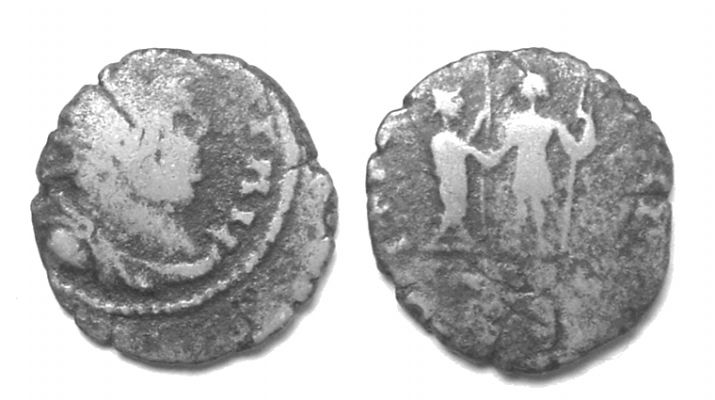
The acquisition of my latest ‘Expectate’ coin of Carausius (fifth coin and the second silver denarius) has prompted this post.
EXPECTATE VENI, Denarius, RIC cf 554
The reverse legend “EXPECTATE VENI” is only found on the Roman coins of the British usurper Carausius. No other emperors used the legend. It comes from Vergil’s Aenid. The legend roughly translates as 'Come O Long Awaited One', although, as Casey (1977) points out, the quote from the Aeneid is somewhat out of context and rather than it being a momentous arrival the original is rather sombre and introspective in mood as it continues:
"And, oh, how harrowing was the sight of him; how changed he was from the old Hector... Now his beard was ragged and his hair clotted with blood, and all these wounds which he had sustained fighting to defend the walls of his homeland could still be seen."
EXPECTATE, Antoninianus, RIC cf 605
The reverse type of the coin, struck at the beginning of Carausius’ reign and shows two figures greeting, occasionally with an altar between them, interpreted as Britannia greeting the new ruler.
EXPECTATE VENI, Antoninianus, RIC cf 605
EXPICTA, Antoninianus, RIC 774
Reference
Casey, P.J; 'Tradition and Innovation in the Coinage of Carausius and Allectus' in Munby, J and Henig, M; Roman Life and Art in Britain (1977)
Monday, 14 August 2017
Roman portraits
As well as having my page attempting to get a portrait of every person who appears on a Roman coin I have also been playing at removing the portrait from the the coin by manipulating the image to paint out the background. The idea was to produce a calendar of Roman portraits for a handful of friends. I thing the results are quite pleasing and by removing the lettering that surrounds the bust you get a better impression of the artistry involved in creating a numismatic portrait.
Julia Domna
Plautilla
Maximinus I
Philip I
Victorinus
Aurelian
Probus
Carausius
Crispus
Constantius II
Saturday, 10 June 2017
Viking hack silver
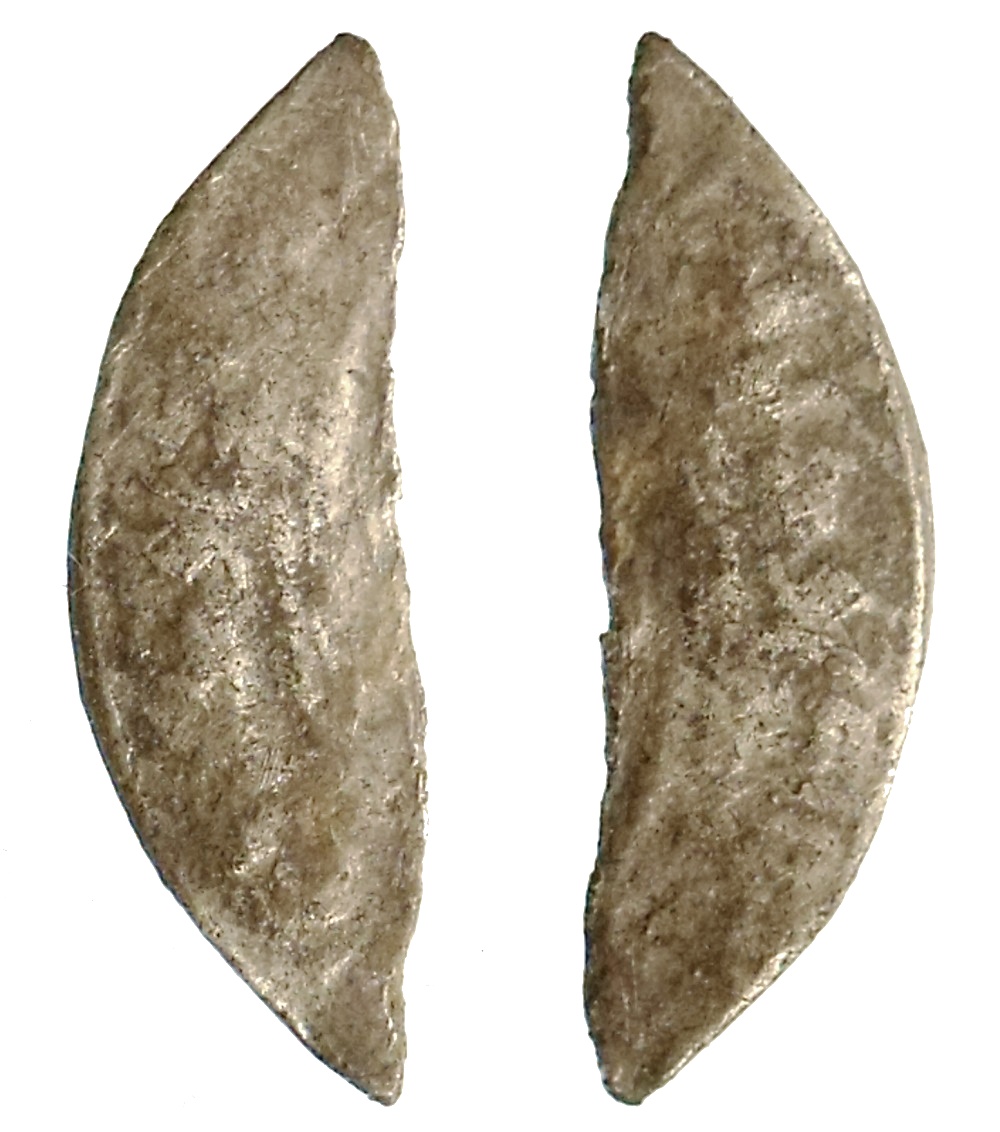
Cut bar hack silver
Following my earier post on the Vikings I want to post a little about hack silver, a prevalent feature of Viking finds. Hack silver is, as the name suggests, cut up bits of silver objects, such as Islamic coins, jewellery etc, but also metal from these sources reformed into bars and strips or even droplets.
Globular hack silver
I had thought that this material was then remanufactured into other items like jewellery or new coin of Viking type but it appears that hack silver itself was used as a form of exchange into the early 11th century and I wonder whether it is any coincidence that the three pieces that I have conform approximately to the weight of a half penny (dirhem fragment, 0.5 grammes), penny (globule, 1 gramme) and three halfpence (cut bar, 1.6 grammes), albeit at a time when the weight of a penny fluctuated greatly, even within a single series.
Islamic Ayyubid dirhem cut, Viking hack silver
It has been postulated that there became a social divide in the use of hack silver as a means of exchange through time where once it had been used universally within Viking culture with the lower strata continuing to use it whilst the more elite began to become a more monetized society. With increasing monetization the range of weights of any particular series of coin became more fixed and the value for exchange was done less by weight and more by recognised value.
Islamic dirham of the Ayyubids, 192 AH
The use of hack silver as a method of exchange seems to have petered out during the 11th century and this has been linked to the debasement of the Islamic dirhems of the Fatimid dynasty.Tuesday, 6 June 2017
Vikings
Exhibition poster
It is thirty-seven years since I went to the great Viking exhibition at the British Museum (and again when it came on tour to the provinces and I saw it in York). At the time the display was hailed as groundbreaking as it presented the Vikings in a less war like manner. In those days the Viking settlement of Coppergate in York was still being excavated and the visitor experience was several years away from opening.
Viking exhibition catalogue, 1980
Now there is a new touring exhibition in York and I am eagerly anticipating my planned visit for Saturday. I went to the museum today to see if I could acquire a copy of the exhibition catalogue ahead of my visit but, unlike in 1980, there is no catalogue for this current show.
Coppergate wood & oyster shells from the Viking waste pits
There seems to be a resurgence in the study of history of Viking Britain and archaeology, and this, combined with the contemporary documentation, has located the winter camps of the micel here, or great army, as it swept through Britain; 871/2 London, 872/1 Torksey (Anglo Saxon Chronicle “Her nam se here wintersetle oet Turcesige”), 873/1 Repton, 874/5 by the Tyne. The last of the camps, the one of the winter of 875/6’ is thought to be on the outskirts of York, a site in the literature known as “Ainsbrook”, a portmanteau name made up from the names of the detectorists who initially located it, or also “Arsny” an acronym of a riverine site north of York.
Ainsbrook finds
The winter camps are not just military establishments entirely garrisoned by men; they are, apparently, functioning mixed gender settlements becoming a hive of economic activity if the preponderance of recovered weights is anything to go by. It would appear that the weights would have been used for, amongst other things, weighing the hack silver and gold, the cut up and sometimes remelted remains of precious metal that includes dirhems, silver coins from the Arab world.
Sunday, 7 May 2017
"Carausius lies here under these stones"
Whilst recently staying in north Wales one of the things I wanted to see was the Roman gravemarker of Carausius. The stone, found during the 19th century, proclaims in coarse Latin epigraphy that “Carausius lies here under these stones”. Above the inscription is a christogram, the amalgamation of the first two letters of the word “Christ” and marks this burial to be overtly Christian.
Carausius is an unusual name, known from Roman history in the form of a Menapian usurper who took Britain out of central Roman control at the end of the third century. Note that Menapiae is in the area of modern Belgium. Interestingly William Stukeley in the 18th century postulated that instead of being from Menapiae that Carausius was Menavian, ie from south Wales.
It is unlikely that this usurper is the same Carausius named on the grave marker as it thought that it probably dates to the fifth or sixth century AD.
Monday, 17 April 2017
Odenathus, the "lion" of Palmyra
I have just been reading a paper in BCEN 2015 on new adventus and profectio types from the mint of Antioch during the sole reign of Gallienus by Charles Euston. In the paper they question whether the control of the Antioch mint was under the control of Odenathus, ruler of Palmyra and Roman ally for some time after the recapture of the mint after the usurpation of Macrianus and Quietus. He doubts the hypothesis of J._M Doyen that aurei and medallions were struck by Odenathus at Antioch to celebrate his own victories.
I recalled a passage in the Sybilline Books that may actually lend support to the Doyen theory of Odenathus promoting his campaign successes. A coin reverse type in the antoninianus series from Antioch features a walking lion, either holding a thunderbolt or, on some types, a bull’s head. The 13th Sybilline book, dealing with this period of Roman history, states from line 210:
The very mighty Romans, one of whom
Shall have the number seventy, and the other
The number three, even then the stately bull,
That digs the earth with his hoofs and stirs up
The dust with his horns, shall many ills
Upon a dark skinned serpent perpetrate
That draws a trail with his scales; and besides,
Himself shall perish. And yet after him
Again shall come another fair-horned stag,
Hungry upon the mountains, striving hard
To feed upon the venom-shedding beasts.
THEN SHALL A FEARFUL LION COME,
Sent from the sun and breathing forth much flame.
And then too by his shameless recklessness
Shall he destroy the well-horned rapid stag
The general commentary accepts that the lion referred to is Odenathus and I just wonder (without wanting to over read the ambition of the die cutter’s intention) whether the lion of the Antioch coin type is a reference to Odenathus.
Subscribe to:
Posts (Atom)